What an actuator does
A humanoid has dozens of joints: shoulders, elbows, wrists, hips, knees, ankles, plus finger joints in the hands. Each joint needs something to push it and something to tell the robot how hard it is pushing. That package is the actuator, and there are two main kinds:
- Rotary actuators turn a joint like a shoulder, elbow, waist or hip. A typical one combines a frameless torque motor, a harmonic (strain-wave) reducer that trades speed for turning force, an encoder, a torque sensor and a driver.
- Linear actuators push and pull in a straight line, used at the knees, hips and some elbows and fingers. They pair a motor with a planetary roller screw, a precision threaded part that is widely described as the hardest component to machine at volume.
Why force control matters
Moving to a position is the easy half. The harder half is controlling how much force a joint applies and sensing what it pushes against. A robot that can feel force can hold an egg without crushing it, stop when it touches a person, and keep its balance on uneven floors. This is why force and torque sensors, and software that reads them, are drawing investment: this week Eka Robotics raised $150 million for a force-sensing gripper and a vision-force-action model (TechCrunch, October 20, 2026). Better force control also tends to be what separates a lab demo from a robot that can safely work next to people.
Who reportedly makes the parts
| Component | Reported suppliers | What it does |
|---|---|---|
| Linear actuators and roller screws | Sanhua, Beite, Wuzhou Xinchun, Xinjian (China); GSA/Rollvis (Switzerland); Schaeffler (Germany) | Straight-line push and pull at knees, hips and fingers |
| Rotary joint modules | Tuopu (China); Schaeffler (Germany); Unitree builds its own | Turns shoulders, elbows, waist and hips |
| Harmonic reducers | Harmonic Drive Systems (Japan); Leaderdrive and Green Harmonic (China) | Gears that multiply turning force in a small space |
| Torque and motor parts | maxon (Switzerland), Kollmorgen (US), TQ RoboDrive (Germany), Moog (US) | Torque-dense motors for joints and hands |
| Force and torque sensors | Keli Sensing (China); Bota Systems (Switzerland), ATI (US) | Let the robot feel how hard it is pushing |
Most of these customer links come from investor disclosures and industry press, not from the robot makers themselves. By one tracker’s count, only a few are officially confirmed: Schaeffler with Humanoid, maxon with Reachy 2, and Hyundai Mobis with Atlas. Treat any supplier-to-Tesla claim as reported, not confirmed.
The numbers behind the cost
- Share of cost: about 50% (Schaeffler) to 60% (Hyundai Mobis) of a humanoid’s materials; the September 2026 teardown synthesis gives 40% to 56%, and notes its own figures are ranges, not audited costs.
- Count per robot: Chinese supply-chain reporting counts roughly 14 harmonic reducers and 14 to 16 roller screws in an Optimus-class robot. These are reported counts, not Tesla disclosures.
- Price gap: the same teardown lists Chinese rotary joint modules at RMB 4,000 to 8,000 against RMB 8,000 to 18,000 for imported equivalents, and linear actuators at RMB 3,500 to 7,000 against RMB 7,000 to 15,000.
- Optimus cost claim: analysts quoted by 36Kr argue an Optimus would cost about $131,000 without Chinese suppliers and about $46,000 with them, against Tesla’s long-run target of $20,000. These are analyst estimates, not Tesla figures.
Where the supply chain is thin
- Single suppliers. Some parts reportedly come from one source, such as Sanhua as the sole assembler of Optimus linear actuators. Makers try to protect themselves with a second source, for example the reported Harmonic Drive and Green Harmonic split.
- China concentration. Chinese industry sources say 50% to 70% of humanoid core-component capacity sits in China. That lowers cost but concentrates risk for robot makers elsewhere.
- Top-grade parts. The most precise roller screws and six-axis torque sensors are still described as gaps.
- Capacity versus demand. About 13,318 humanoids shipped in 2025 (humanoid.guide, February 2026). Leaderdrive reportedly sold 425,158 reducers in 2025, up 72%, and announced capacity of 1.44 million reducers by the end of 2026. The article that reports this argues those plans assume a market about 100 times larger than today’s, so factories could be built ahead of demand. Reducers also go into industrial robots, so reducer sales are not a count of humanoids.
- Unreliable share data. Market-share figures conflict: Green Harmonic is credited with both 25% and over 60% of China’s reducer market depending on the source. Use them as directional only.
What to watch
Financial signal: if humanoid shipments climb from thousands into the hundreds of thousands, the first pressure shows up in actuator parts (reducers, roller screws, torque sensors) before it shows up in the robots themselves. Watch supplier capacity announcements against actual humanoid shipments, price cuts on joint modules, and any confirmed supplier deals from the robot makers. A supplier’s order headline, such as the reported $685 million Sanhua Optimus order in October 2025, is a claim until the buyer or an audited filing confirms it. Not investment advice.
Watch: how the parts work
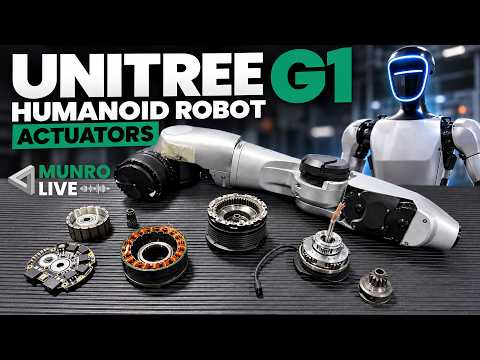

Links open on YouTube. Videos are outside sources we have not verified beyond their descriptions.
Related reading
For market size context see what Goldman Sachs and Morgan Stanley actually project, and for fund exposure see BOTZ vs. KOID vs. ROBO compared. Our humanoid company table lists who is building the robots.
Sources: Humanoid.guide, Who Builds the Joints? The Humanoid Actuator Supplier Landscape in 2026; Robotichina, Humanoid Robot BOM Cost Breakdown 2026 (September 21, 2026); TechCrunch (October 20, 2026) for Eka Robotics. Several figures originate with 36Kr, Yicai and company filings as relayed by these sources and have not been independently verified.